
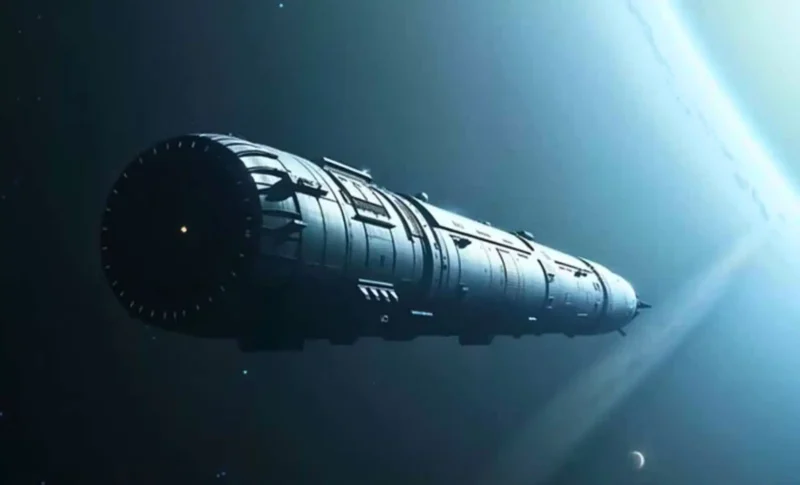

In the realm of interstellar exploration, the Chrysalis Starship emerges as a groundbreaking concept poised to redefine humanity’s reach beyond our solar system. This massive 36-mile-long vessel, designed to carry up to 1,000 humans (with detailed plans supporting a population of 2,400 across generations), promises a one-way journey spanning 400 years to distant stars. Unlike traditional spacecraft, the Chrysalis Starship incorporates advanced artificial gravity, self-sustaining ecosystems, and fusion propulsion to enable deep space travel without return. Winning the 2025 Hyperion competition, this design not only captivates with its architectural renderings but also serves as a comprehensive roadmap highlighting technological feats and unresolved challenges in generation ship engineering. As we delve into the intricacies of the Chrysalis Starship, discover how it could pave the way for humanity’s first interstellar voyage.

The Vision Behind the Chrysalis Starship: A No-Return Interstellar Voyage
The Chrysalis Starship is more than a vehicle; it’s a self-contained world engineered for perpetual habitation during deep space travel. Conceived as a generation ship, it addresses the monumental task of transporting humans across interstellar distances, where journeys last centuries. The core purpose? To ferry colonists to exoplanets, preserving human civilization through 16 generations without resupply from Earth.
This ambitious project draws from decades of science fiction and real-world research, evolving from early concepts like Project Orion to modern inspirations from NASA’s studies on long-duration spaceflight. The Chrysalis Starship stands out by integrating practical elements such as mass budgets, rotation calculations for artificial gravity, and governance models to avert societal breakdowns. Its “no way back” philosophy underscores the commitment required for interstellar travel, emphasizing sustainability and resilience in the void of space.
Experts view it as an “inventory of unknowns,” pinpointing gaps in current technology while proposing innovative solutions. For instance, the design assumes assembly at Lagrange points—stable gravitational zones in space—to minimize fuel costs and facilitate large-scale construction. This strategic choice highlights the Chrysalis Starship‘s focus on feasibility, even as it pushes the boundaries of deep space exploration.
Key Features of the Chrysalis Starship for Sustained Deep Space Travel
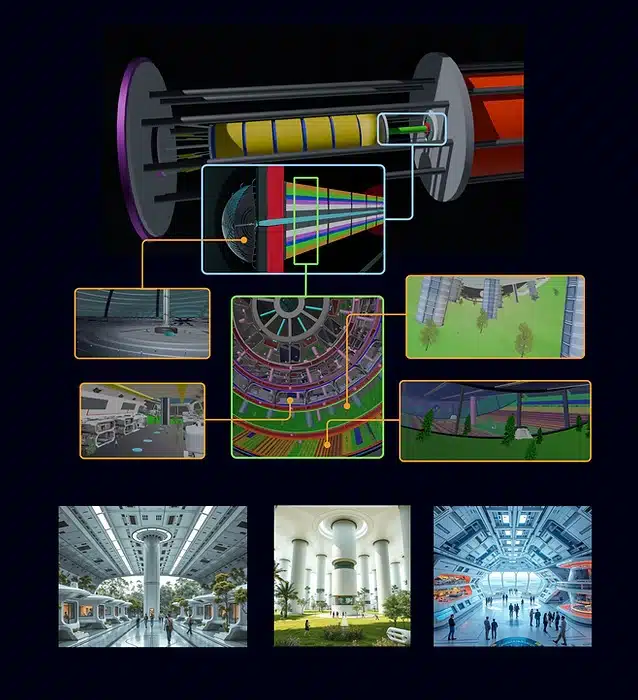
At the heart of the Chrysalis Starship lies a suite of cutting-edge features tailored for multi-generational interstellar travel. The vessel’s nested cylindrical structure rotates to simulate artificial gravity, countering the debilitating effects of zero-gravity on human health. Outer layers spin to generate 0.9 times Earth’s gravity, while inner shells rotate oppositely to stabilize the system and reduce structural stress.
Life support systems form a closed-loop ecosystem, recycling 98% of water and air based on International Space Station (ISS) data. Agricultural modules integrate seamlessly, allowing the crew to grow food in a self-sustaining biosphere. Drawing lessons from Earth’s Biosphere 2 experiments, the design mitigates risks like atmospheric instability, ensuring ecological balance over 400 years.
Propulsion relies on a hypothetical Direct Fusion Drive using helium-3 and deuterium, enabling one year of acceleration, a 400-year coasting phase, and one year of deceleration. This fusion technology, though not yet realized, promises efficient deep space propulsion far superior to chemical rockets.
Social engineering is equally innovative. Crew selection mirrors Antarctic overwintering protocols to identify isolation-tolerant individuals. Governance incorporates AI-assisted decision-making, community-based child-rearing, and voluntary birth spacing to maintain population stability. Knowledge preservation systems safeguard technical expertise and cultural heritage, preventing the loss of critical information across generations.
The forward-tapering habitat minimizes collision risks with interstellar debris, complemented by provisional radiation shielding against galactic cosmic rays and solar particles. These features collectively make the Chrysalis Starship a beacon for future generation ships, blending engineering prowess with human-centric design.
Detailed Specifications of the Chrysalis Starship
To grasp the scale of this interstellar spacecraft, consider its impressive specs:
- Dimensions: Stretching 58 kilometers (approximately 36 miles), the Chrysalis Starship‘s length is dictated by rotation physics. It rotates at under two revolutions per minute to avoid disorientation, necessitating a vast structure for effective artificial gravity.
- Capacity: Designed for 1,000 humans initially (expanding to 2,400 across generations), with provisions for controlled population growth.
- Gravity Simulation: Nested cylinders provide 0.9g, with counter-rotation for stability.
- Life Support: 98% water recycling efficiency; fully closed biological loops for air, water, and food production.
- Propulsion: Direct Fusion Drive; acceleration/deceleration phases bookend a long coast.
- Power Source: Fusion reactors with vacuum radiators and long-lasting shielding.
- Assembly Location: Lagrange points for low-energy positioning.
- Shielding: Engineered barriers against radiation and debris, though materials remain developmental.
Here’s a tabulated overview of core components:
| Component | Description | Key Specs |
|---|---|---|
| Structure | Nested rotating cylinders | 58 km length, <2 RPM rotation |
| Artificial Gravity | Centrifugal force simulation | 0.9g equivalent |
| Life Support | Closed-loop ecosystem | 98% recycling, agricultural integration |
| Propulsion | Direct Fusion Drive | Helium-3/deuterium fuel, 400-year mission profile |
| Radiation Shielding | Provisional engineered materials | Protection from cosmic rays and solar events |
| Governance | AI-assisted models | Community child-rearing, knowledge preservation |
These specifications underscore the Chrysalis Starship‘s role as a pioneer in deep space travel technology, blending proven concepts with forward-thinking innovations.
Challenges in Realizing the Chrysalis Starship for Interstellar Travel
Despite its visionary design, the Chrysalis Starship faces formidable hurdles. Structural assembly at 58 km scale exceeds current launch capabilities, requiring off-Earth construction at Lagrange points—a feat untested at this magnitude.
Propulsion and power systems hinge on undeveloped fusion technology. While ground-based fusion reactors advance, spacecraft variants demand features like vacuum-compatible radiators and centuries-durable shielding, which are decades away.
Radiation protection poses another gap: Effective shielding against galactic cosmic rays requires thick, heavy materials impractical for current launches. Life support challenges echo Biosphere 2’s failures, where atmospheric imbalances threatened viability—amplifying risks for a 400-year deep space voyage.
Social stability remains the most unpredictable. With no analogs for centuries-long confinement, the design relies on unproven models from short-term missions like ISS stays or Antarctic expeditions. Psychological stressors, governance breakdowns, and cultural drift could jeopardize the mission.
Overall, the Chrysalis Starship highlights these “unknowns” as opportunities for research, urging advancements in fusion, ecology, and sociology to make interstellar generation ships a reality.
Future Implications of the Chrysalis Starship in Deep Space Exploration
The 2025 Hyperion win positions the Chrysalis Starship as a catalyst for innovation in interstellar travel. By detailing system integrations and redundancies, it bridges conceptual dreams with engineering realities, inspiring collaborations among space agencies, private firms like SpaceX, and academic institutions.
Looking ahead, prototypes could test subsystems—such as mini-biospheres or fusion drives—paving the way for scaled implementations. Implications extend beyond travel: Technologies like advanced recycling and artificial gravity could enhance Earth-based sustainability and long-duration Mars missions.
As humanity eyes exoplanets via telescopes like the James Webb, the Chrysalis Starship embodies the audacity of deep space travel. It challenges us to evolve from planetary dwellers to stellar nomads, ensuring our species’ survival amid cosmic uncertainties.
In summary, the Chrysalis Starship represents the pinnacle of generation ship design, offering a blueprint for carrying 1,000 humans (and sustaining thousands more) on an eternal interstellar voyage. As research progresses, this concept could transform science fiction into achievable destiny, ranking it among the most searched topics in space exploration today.
